Andromeda – Beyond the Blue

Hopefully we are all aware of the fact that ultraviolet rays from the Sun are bad for our skin.  The reason they are hazardous is because of the high energy that that they possess, which allows them to penetrate our skin and damage the cells internally. UV is a small part of our Sun’s emissions but UV radiation is a major component of the energy emitted by very hot, massive stars, as can be seen in the image below from NASA’s Galex (Galaxy Evolution Explorer) satellite.

Andromeda Galaxy in UV - Image courtesy of NASA

These stars that line the arms of the Andromeda galaxy are the result of dust and gas that form the structure of the arms and consequently, the birthing place of new stars.  Blue giants have very high surface temperatures ranging from 10,000 to more than 40,000 degrees Kelvin.  The more massive the star, the hotter it is and the more it will radiate in the ultraviolet.  But, running hot and massive comes with a cost.  These blue giants will burn out in supernovae in a few tens of million of years. (A very short time – astronomically speaking!)  Compare this with our Sun, which has a surface temperature of about 6000 degrees Kelvin and will be around for at least 10 billion years.

Below you can see Andromeda in a Hubble image in the optical spectrum fading to the ultraviolet image from Galex.  It’s easy to see that these high-powered stars reside in the dusty arms of the galaxy.  In a few million years the Milky Way Galaxy will have a ring-side seat to view these blue giants as they spectacularly end their lives!
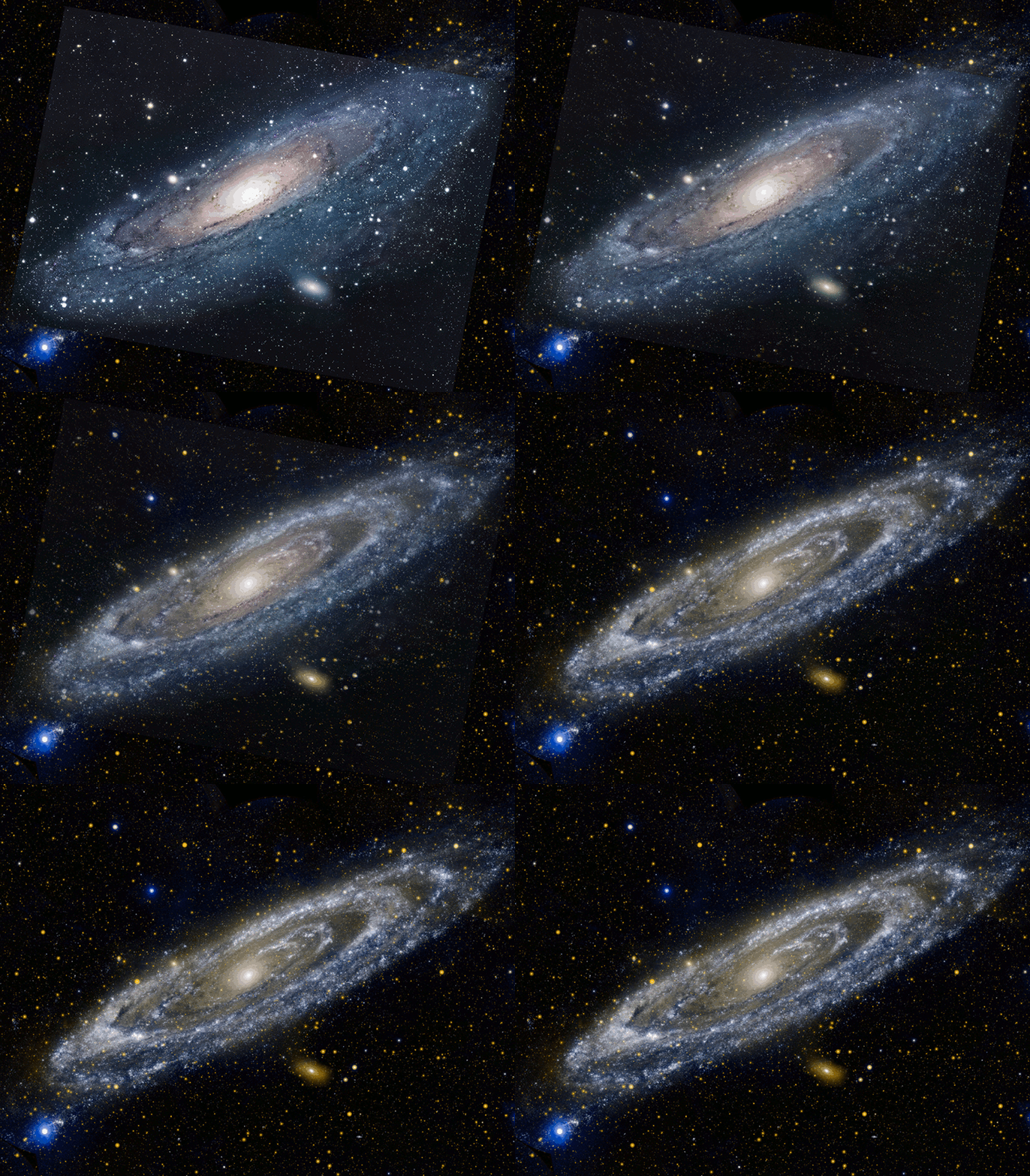
Andromeda from Hubble in visual and UV from Galex

For more on the Andromeda galaxy take a look at an earlier post to see Andromeda in a different light: The Many Faces of Andromeda.

Till next time,

RC Davison
Dwarf Galaxy NGC 2366 and Beyond!

A smudge in the night sky can contain many wonders!

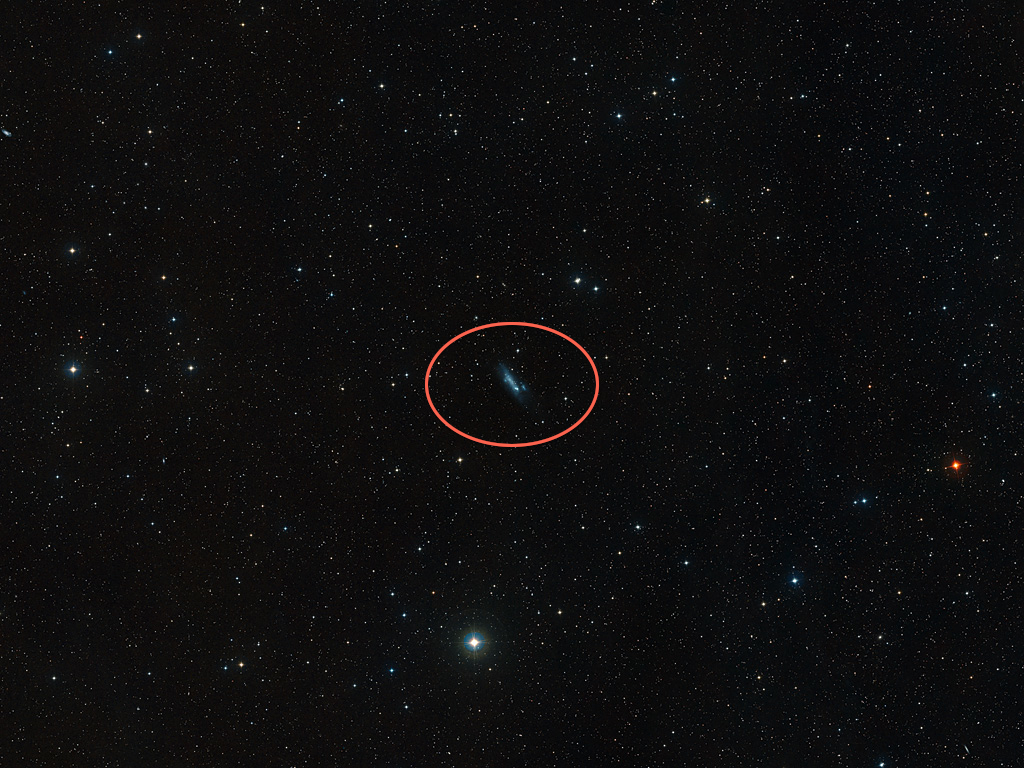
Ground-based, wide-field view of NGC 2366 from Digital Sky Survey 2 - Image courtesy of NASA

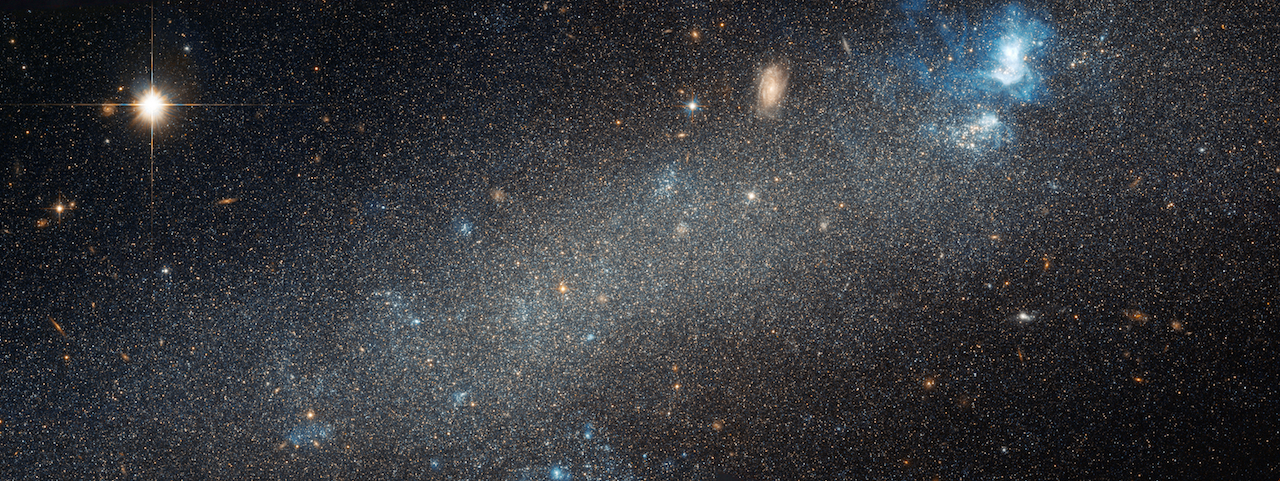
The blue streak in the above image is the dwarf galaxy NGC 2366.  It is about 10 million lightyears distant and located in the constellation Camelopardalis (the Giraffe), which is visible in the northern hemisphere.  Barely visible to the bottom right of the blue smudge is a bright spot, which is an active star-forming nebula, NGC 2363 contained within the dwarf galaxy.  In the image below you can see the nebula shining from the light of the hot blue stars that are forming in the upper right part of the galaxy.

Hubble view of NGC 2366 - Image courtesy of the NASA/ESA Hubble Space Telescope

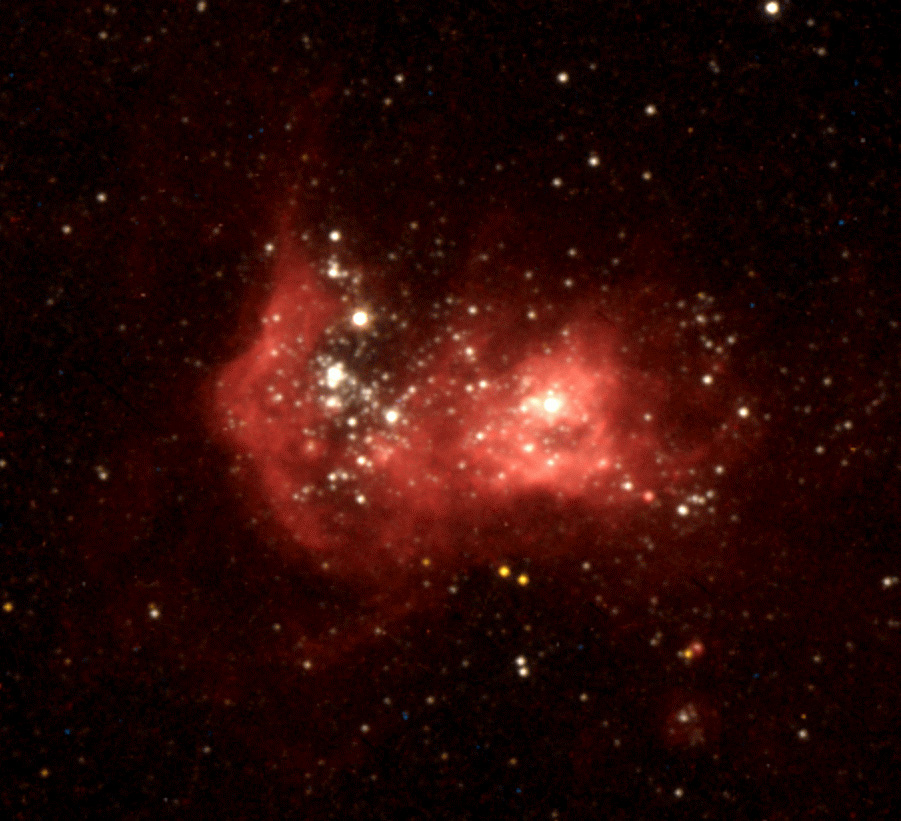
Zooming in on the nebula in another Hubble image below, one can see the collection of bright stars embedded in the nebula.  Of particular note is the very bright star that appears at the tip of the “hook” of the nebula.  This massive star is known as a Luminous Blue Variable (LBV), which is about 30 to 60 times as massive as the Sun.  This is a very rare type of variable and very unstable.  The image captured the star during an erupting phase.  Another, more famous star of this type is the giant, Eta Carinae, which is anticipated to turn into a supernova in the near future (astronomically speaking).

NGC 2363 - Star forming nebula in the dwarf galaxy NGC 2366 - Image courtesy of NASA

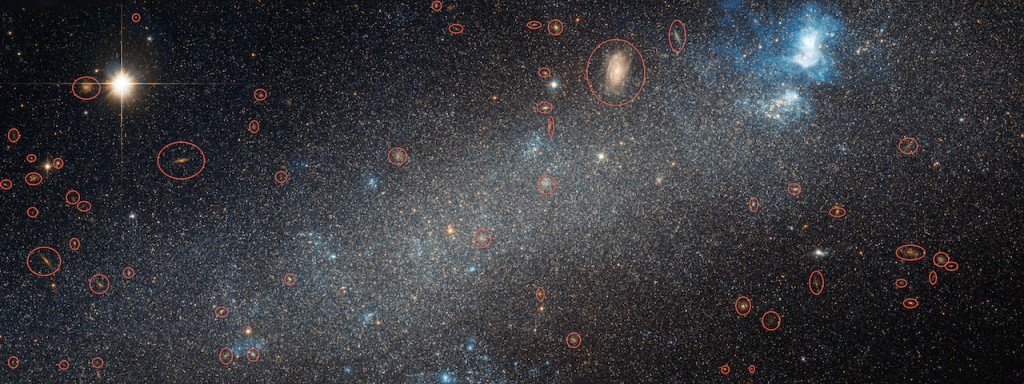
When you look closely at the image of NGC 2366 you will see many “nebulous” regions within it.  They are actually very distant galaxies that are visible through the veil of the dwarf galaxy.  I’ve highlighted some of the more prominent galaxies that can be found in the image below.

Galaxies beyond NGC 2366 - Base Image courtesy of NASA/ESA Hubble Space Telescope

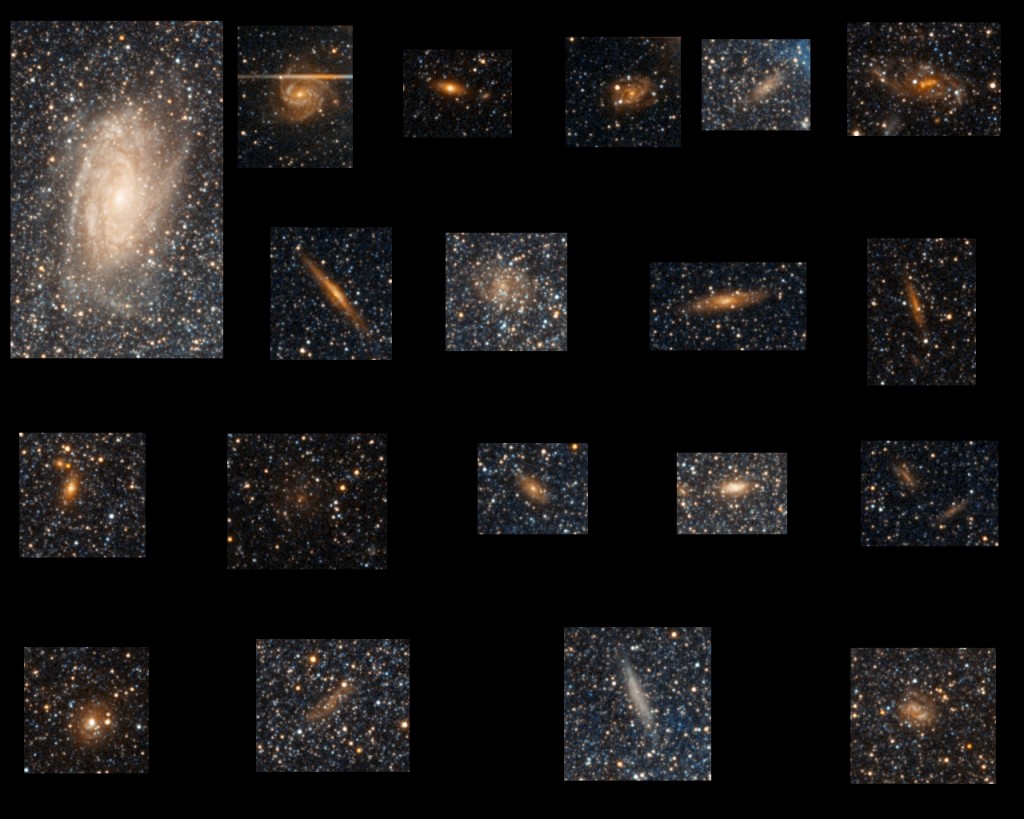
Here is a composite of some of the major galaxies hiding behind this dwarf galaxy.

Galaxies behind the dwarf galaxy NGC 2366

NGC 2366 is just another example of what wonders are hidden within the smallest parts of the night sky and what amazing things are awaiting discovery.

Till next time,

RC Davison

Resource: Hubble Space Telescope NASA/ESA Hubble Observes a Dwarf Galaxy with a Bright Nebula