In The Spirit of Halloween

For those of you that celebrate, appreciate, or just tolerate Halloween, I offer you a cosmic witch to look out for!

Witch's Nebula in the Orion Nebula - Courtesy of Star Shadows Remote Observatory

Catching some rays from Orion’s blue supergiant – Rigel, the witch is actually a reflection nebula (hence the bluish color) that is over 50 light-years long.   The Witch Head Nebula (IC 2118) is about 1000 light-years distant, so we have nothing to fear from this witch on Halloween!

Click the link for more information about, and a larger image of the Witch Head Nebula.

Till next time,

RC Davison

Stars In Motion!

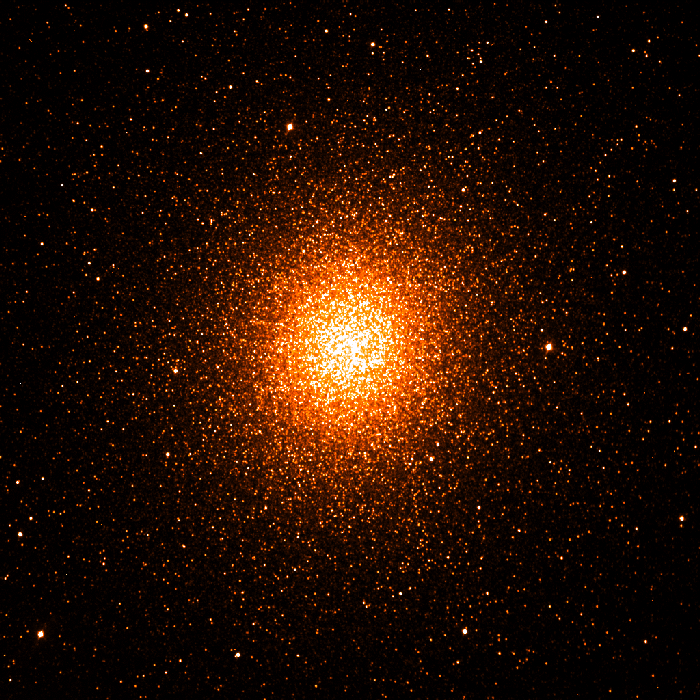
When I look at a globular cluster like Omega Centauri I always imagined that the 10 million stars in the cluster rotated majestically about a central mass in an orderly fashion.

Globular Cluster Omega Centauri - Image courtesy of the University of Michigan

Thanks to some new work by two astronomers from the Space Telescope Science Institute in Baltimore, Md, my peaceful, orderly vision of a globular cluster has been trashed!

Jay Anderson and Roeland van der Marel, using data from the Hubble Space Telescope, have measured the velocities of some of the stars at the heart of the cluster and their motion is far from peaceful!

In the close-up image below, we see the brilliant blue and red stars that reside in the center of this ancient globular cluster.  The area in the rectangle is magnified and displayed below showing the relative velocities of the stars contained within.

Using Hubble to Chart the Future Motions of Stars Within a Cluster

Source: Hubblesite.org

This motion was gleaned from images Hubble took in 2002 and 2006.  Its precise optics allowed the astronomers the ability to measure the relative motion of these stars over such a short period of time.

In the Hubble clip below, you will zoom into the heart of Omega Centauri and ultimately see the predicted motions for these stars over the next 10,000 years.  It is interesting to note that this random motion gives astronomers clues that may dispel the theory of a massive black hole at the center of globular clusters.  There may be a black hole present, but it would not be equivalent to the massive black holes found in the center of galaxies, like the one at the center of the Milky Way, which is about 4 million times the mass of our Sun.

Till next time,

RC Davison

Inside The Milky Way

Inside The Milky Way” is a new production by the National Geographic Channel that aired Sunday night and will be broadcast again on Thursday, October 28th at 9 pm.  I saw most of the program and highly recommend it.

Stunning visuals, animations, and the latest hot topics in astronomy are intelligently discussed in this 2-hour program.  Black holes, dark matter, galactic superclusters, and the Andromeda/Milky Way collision (In about 2 billion years – don’t sweat it!) are some of the topics covered.  (Just ignore the sound effects for the supernova!)

Check out the web site for some videos and photos.  Enjoy!

Till next time,

RC Davison

Do They Know We’re Here? – Clarification

My post on August 21, 2010, “Do They Know We’re Here?” contains a bit of misinformation, which I hadn’t thought of until reading the latest Planetary Report from the Planetary Society.

While we’ve been experimenting and transmitting radio signal for over a 100 years, those early transmissions were low frequency, typically 1 MHz or less.  The ionized layer of our atmosphere – the ionosphere, reflects those signals back down to the surface, so they won’t escape the planet.

If any of you have listened to AM radio (Remember that?) at night, you find that you can pick up stations from 100s to 1000s of miles away, whereas you can’t hear them during the day.  This is because at night, the sunlight is no longer showering the atmosphere with UV radiation, which knocks electrons off the oxygen and nitrogen atoms charging them – ionizing them.  The lower layer of the ionosphere rapidly dissipates when the Sun sets, leaving the higher layers to reflect the AM transmissions, allowing them to reach much further.

We don’t see this with our FM radios,  because they operate at much higher frequencies (in the 10-100 MHz range) and don’t rely on the ionosphere to  reflect them to your radio.  For your radio to receive your favorite FM station, you have to be able to receive the signal directly from the transmitting antenna, this is why they are called “line-of-sight” transmissions.  These higher frequencies were used commercially for FM radio and early television in the early 1930s, and they blasted right through the ionosphere and out into space.

So, a long winded explanation to say that we’ve really been broadcasting to the cosmos for about 75 years, as opposed to the 100 years mentioned in the earlier post.

Comments always welcome!

Till next time,

RC Davison

It’s Full of Stars!

Initially, I was just going to put up a link to the European Southern Observatory’s list of top 100 images, which has enough pictures to keep any fan of the cosmos happy.  But, I made the mistake of checking out NASA’s Hubble site, which has a huge collection of images, and I compounded that mistake by looking at the European Space Agency’s (ESA) site for Hubble.  Wow!  I think I’ve overloaded my neural-net!

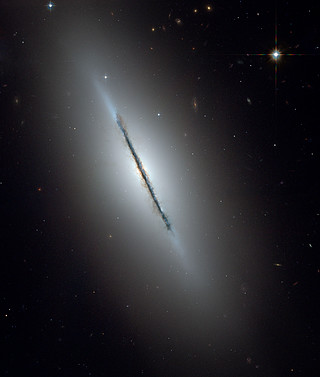
There is just way too much to look at on these sites!  As a tantalizing tidbit, take a look at this beautiful Hubble image of the spiral galaxy NGC 5866 seen edge on.

Spiral Galaxy NGC 5866 Seen Edge On - Hubble Image

Click on the link above for larger images (down-loadable) where you can enjoy the exquisite detail Hubble captured of this galaxy.

One last thing.  ESO is running a contest – ESO’s Hidden Treasures for anyone that has an interest in creating a new image from their data archives.  They provide instructions on what you have to do to create the image, but hurry, the contest ends on November 30, 2010.

Till next time,

RC Davison

UFOs – Real or Imaginary?

UFOs seem to be popping up in the news.  China is having a rash of sightings compromising certain airports in their country, and the National Press Club had a news conference on September 27, 2010 with retired Air Force personnel recounting their experiences.

So, UFOs, real or imaginary?

To paraphrase Carl Sagan, extraordinary claims require extraordinary evidence, we have to ask, where’s the evidence?  Surely, UFOs are extraordinary objects, but we don’t seem to have the hard physical evidence.  Some might argue that there is physical evidence, but it is locked up on some high security military base, or buried in a nondescript government warehouse.  So, the general public doesn’t have access to that.  What we do have is a small percentage of sightings that can not be explained as the planet Venus, weather balloons, airplanes, etc.  Within this group of unexplained cases we find that a percentage of those sightings were made by people with professional backgrounds—pilots, police officers, military personnel, and astronauts— that lend credibility to their reports.  They knew enough and had enough experience to report an incident that could not be dismissed with one of the typical explanations.

I think we are too short-sighted and conceited to admit that there is other intelligent life in our galaxy/universe.  The argument is often put forth that the physics prevents interstellar travel, so it is impossible that these sightings are extraterrestrial in origin.  To think that we know everything there is to know about the physics of the cosmos is as faulty today as it was in the late 1800s when scientists thought there was nothing more to learn.  They had discovered electricity, magnetism, gravity…What else was there to discover?  It was around the turn of the century that X-rays were discovered, and a few years later Einstein came up with his theories about the photoelectric effect and relativity, and it goes on and on.  There is a lot out there we haven’t a clue about yet!

For me, it’s not hard to see that we don’t know everything about everything.  And, with over 300 billion stars in this galaxy, which is over 10 billion years old, and with an unimaginable number of planets orbiting those stars, odds are that there are many extraterrestrial civilizations out there.  Personally, I think that they’ve been here and checked us out more than once.

Why?  Who knows?  Maybe one day we will get to ask them in person.

I’ve been working on a new novel for the last year or so that involves a unique UFO encounter.  This all adds incentive to finish it up sooner!

Till next time,

RC Davison